

Cambridge IGCSE Maths 0580 Paper 2 is the Extended non-calculator paper. In the 2025–2027 syllabus it lasts 2 hours, carries 100 marks and contributes 50% of the qualification. Cambridge can assess Extended content except the objective on using a calculator. Build your practice around methods you can reproduce by hand across the syllabus. Cambridge 0580 syllabus, assessment overview and Paper 2 details
Which 0580 paper is non-calculator?
| Entry | Non-calculator paper | Duration | Marks | Companion paper |
|---|---|---|---|---|
| Core | Paper 1 | 90 minutes | 80 | Paper 3, calculator |
| Extended | Paper 2 | 120 minutes | 100 | Paper 4, calculator |
Both routes split their weighting equally between the two papers. Check your tier before downloading practice material. A filename ending in 0580/22 identifies Paper 2, variant 2, while 0580/12 identifies Paper 1, variant 2. Your school can confirm your components. How Cambridge paper variants work
What topics should I practise without a calculator?
Use this checklist to diagnose skills. The complete Extended syllabus also includes areas such as transformations, vectors and statistics. Practise questions from across the document so a strong arithmetic session does not leave gaps elsewhere.
| Skill | What to put on paper | A useful check |
|---|---|---|
| Fractions and ratios | Simplify before multiplying and show how you form a common denominator | Check whether the result should be above or below one |
| Percentages | Write the multiplier or work in easy percentage chunks | Identify the starting amount before reversing a change |
| Indices and surds | Keep exact values and show each use of an index law | Confirm which terms are under the root |
| Algebra | Keep one equivalent equation per line | Substitute your answer into the original equation |
| Geometry and mensuration | Name the rule or formula and preserve π when an exact answer is requested | Check units and whether dimensions are radii or diameters |
| Probability | Label branches or outcomes before calculating | Check the total probability and any changing denominators |
Four worked non-calculator practice questions
These are original practice questions. Try each one on paper before reading the solution. If your arithmetic is correct but the result fails the check, compare the equation you wrote with the quantity the question asked for.
1. Cancel before you multiply
Question. Evaluate 14/15 × 25/21 as a fraction in simplest form.
Working. Divide 14 and 21 by 7 to get 2 and 3. Divide 25 and 15 by 5 to get 5 and 3. Multiply the remaining numerators and denominators to get 10/9. The factors you cancel must be on opposite sides of the fraction bar. Cancellation cannot be applied across addition.
2. Reverse a percentage change
Question. A jacket costs 68 after a 15% discount. Find the original price in the same currency.
Working. The sale price is 85% of the original. Write 85% as 17/20. Then 68 × 20/17 = 4 × 20 = 80. Check by taking 15% of 80, which is 12, and subtracting it. Adding 15% of 68 would use the sale price as the base.
3. Keep the surd exact
Question. Simplify √72 − √18 + √8.
Working. Factor out the largest square you spot in each radicand. The three terms become 6√2, 3√2 and 2√2. Combining their coefficients gives 5√2. A useful check is that each root was simplified separately before any addition or subtraction.
4. Find both solutions
Question. Solve x² − 7x + 12 = 0.
Working. Find two numbers that multiply to 12 and add to −7. They are −3 and −4, giving (x − 3)(x − 4) = 0. Set each factor equal to zero to obtain x = 3 or x = 4. Substitute both back into the original expression. Writing only one solution leaves half the result missing.
Build a practice paper in PrickyAI
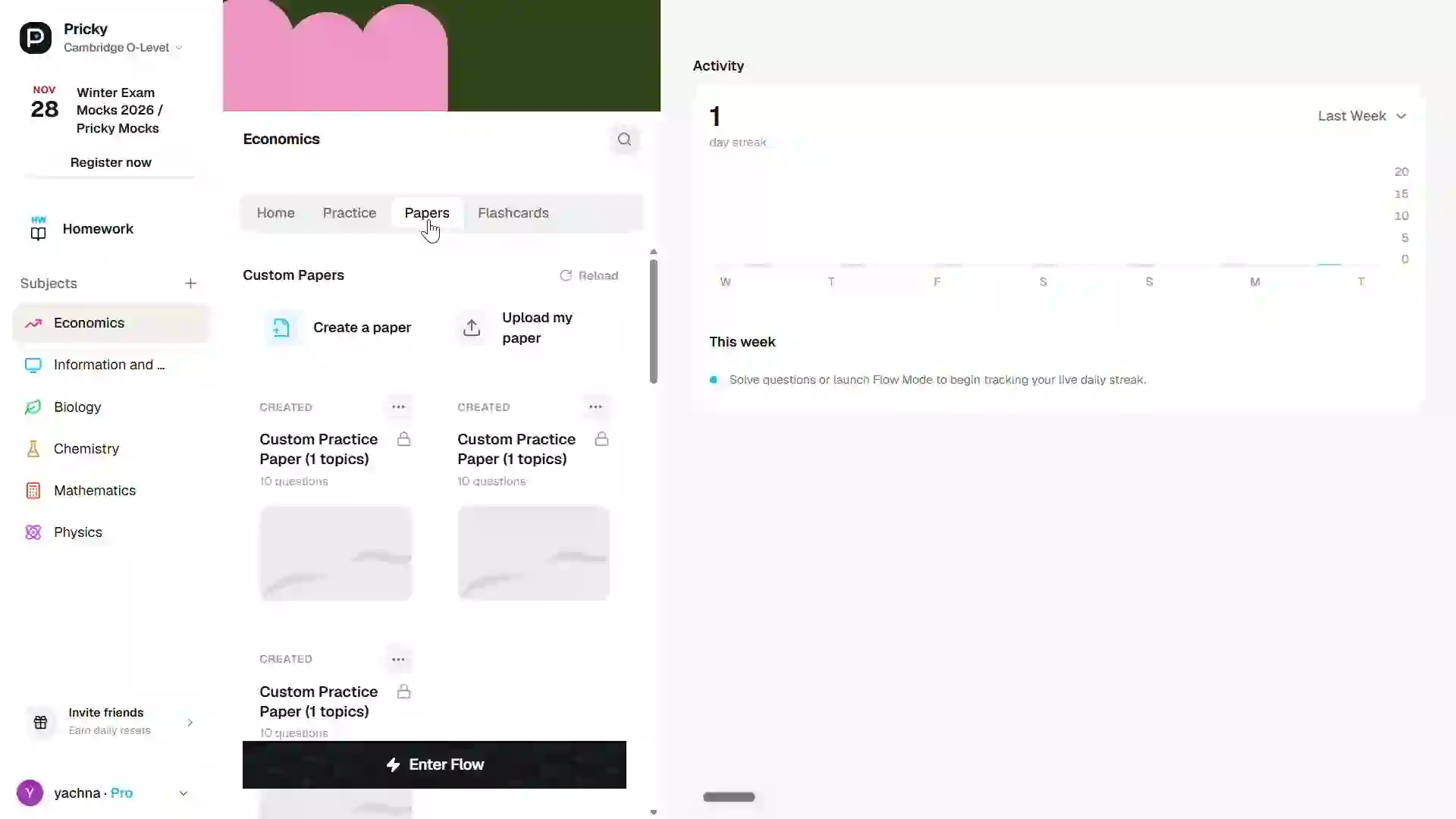
Choose questions for a practice session and work through the paper in the app.
How to use specimen papers and past papers
Start with the official Extended Paper 2 specimen for the layout, formula page and style of questions. Cambridge also provides selected 0580 past papers and marking materials. Use a 2025-or-later paper for a full-format mock and check that the question paper and mark scheme share the same year, series and component code.
After marking, log one specific reason for every dropped mark. “Misread what the percentage was based on” gives you something to fix. “Bad at percentages” does not. Redo one question of the same type with different numbers, then return to the original after a day or two. Keep handwritten working even when your mental arithmetic is fast so you can trace mistakes back to the exact step.
How to use the formula page without losing time
The formula page helps when you recognise the shape or relationship. Before substituting numbers, label the values on the question diagram. A cylinder with radius 3 cm and height 5 cm has volume π × 3² × 5 = 45π cm³. If the question gives the diameter as 6 cm, show how you get the radius before using the formula. That one line makes it easier to spot a substitution mistake during your check.
Practise reading the final instruction before deciding whether to convert an answer. If a question requests an exact answer in terms of π, stop at 45π. If a question requests a fraction in simplest form, stop after you have checked it cannot be reduced. When a question asks you to show a given result, work towards it from the information provided and include the intermediate calculation. The printed result alone cannot show that you know how to obtain it.
A five-session non-calculator plan
- Baseline. Do a mixed set without a calculator. Mark the questions and identify the two skills that caused the most errors.
- Arithmetic. Alternate fractions, ratio, percentages and standard form. Use estimation to check each exact result.
- Algebra and geometry. Write full working for equations and mensuration. Check answers by substitution or by units.
- Timed paper. Use the full 120 minutes if you are taking Extended. The paper averages 1.2 minutes per mark. Treat this as a pacing check and return to questions that stall you.
- Repair. Redo missed questions without looking at the solutions. Repeat the parts where you needed a hint and log what you will change on the next mock.
For planning across subjects, use the Feb/March revision playbook. To interpret marked mocks after you have both paper scores, read the Cambridge grade thresholds guide.
Four more Paper 2 questions for a mixed set
Do these original questions in one sitting. Write the setup for each before doing the arithmetic. If you finish quickly, check the form of your answer and test it against the original question.
Standard form: add quantities with different powers of ten
Question. Give 3.4 × 10⁵ + 8.2 × 10⁴ in standard form.
Working. Write the second term as 0.82 × 10⁵. The sum is (3.4 + 0.82) × 10⁵, so the answer is 4.22 × 10⁵. You can check by adding 340,000 and 82,000. Align the powers of ten before adding the coefficients.
Probability: draw twice without replacement
Question. A bag contains three red counters and two blue counters. Draw two counters without replacement. Find the probability that the counters have different colours.
Working. The two possibilities are red then blue, and blue then red. Their probabilities are 3/5 × 2/4 = 3/10 and 2/5 × 3/4 = 3/10. Add them to get 3/5. The denominator on the second draw is four because one counter has already been removed. Both orders count.
Mensuration: combine exact lengths
Question. A semicircle has diameter 12 cm. Give its perimeter in terms of π.
Working. The curved edge is half the circumference of a circle of diameter 12 cm, so it measures 6π cm. Add the straight diameter to get (6π + 12) cm. A quick sketch helps here because the boundary has two pieces. The formula page gives the full circumference. You still have to decide which part of the circle and which straight edges are in the question.
Algebra: solve an equation with fractional terms
Question. Solve (x + 1)/3 − (x − 2)/2 = 1.
Working. Multiply every term by six to obtain 2(x + 1) − 3(x − 2) = 6. Expand to get 2x + 2 − 3x + 6 = 6. Then −x + 8 = 6, so x = 2. Checking gives 3/3 − 0/2 = 1. The minus sign applies to the entire second bracket.
How to mark your working after a 0580 Paper 2 mock
Use the matching mark scheme and compare one question at a time. In the official 0580 specimen scheme, some rows show separate partial-credit criteria. Find the relevant row, read the required form of the answer and mark where your written working meets each criterion. For a wrong answer, distinguish an incorrect method from an arithmetic slip after a valid setup. Cambridge 0580 Extended Paper 2 specimen mark scheme
Try a new version of the weakest question the next day. If you got the probability example wrong, change the number of each colour and write both orders before multiplying. If the semicircle example caught you out, draw a quarter circle and label the pieces of its perimeter. A new question shows whether the correction transfers.
Set up a non-calculator session in PrickyAI
Select Mathematics in PrickyAI and start with a topic that cost you marks. Work by hand and use the answer feedback to find the first line worth correcting. When building a mixed set, check the source of the questions and use the current 0580 Extended format when you want a full Paper 2 mock. Keep your own short list of exact-form and sign errors to check in the last few minutes.