

A Cambridge IGCSE paper variant is a version of an assessment component. Use the full syllabus and component code, together with the year and series, to match a question paper to its mark scheme.
Read a component code
In Physics 0625/42, 0625 identifies the syllabus and 42 identifies the specific Paper 4 component. A paper labelled 0625/41 and one labelled 0625/42 can test skills from the same syllabus with different questions. Keep the entire component code when recording your practice score. This makes it easier to find the paper again and to look up the correct combination of components in the threshold table. How to read grade thresholds
Confirm your entry with your school
Cambridge publishes timetables by administrative zone and separate information for the March series. Your exams officer can confirm your actual components, session and local arrangements. Use the timetable for your own entry when deciding which exam to prepare for next. The availability of a past paper online tells you which paper it is, while your statement of entry tells you which component you are entered for. Cambridge exam timetables · Cambridge March series
Match the question paper and mark scheme
- Check the syllabus and tier. A Core paper can help with selected questions, while an Extended mock should use the relevant Extended component.
- Match the full component code. The mark scheme for 0625/42 belongs with that component, even when the same topic appears on another version.
- Match the year and series. The same code can appear in March, June and November materials.
- Check the current format. For example, Mathematics 0580 Paper 2 became non-calculator from 2025. Use the current format for a complete mock. 0580 Paper 2 guide
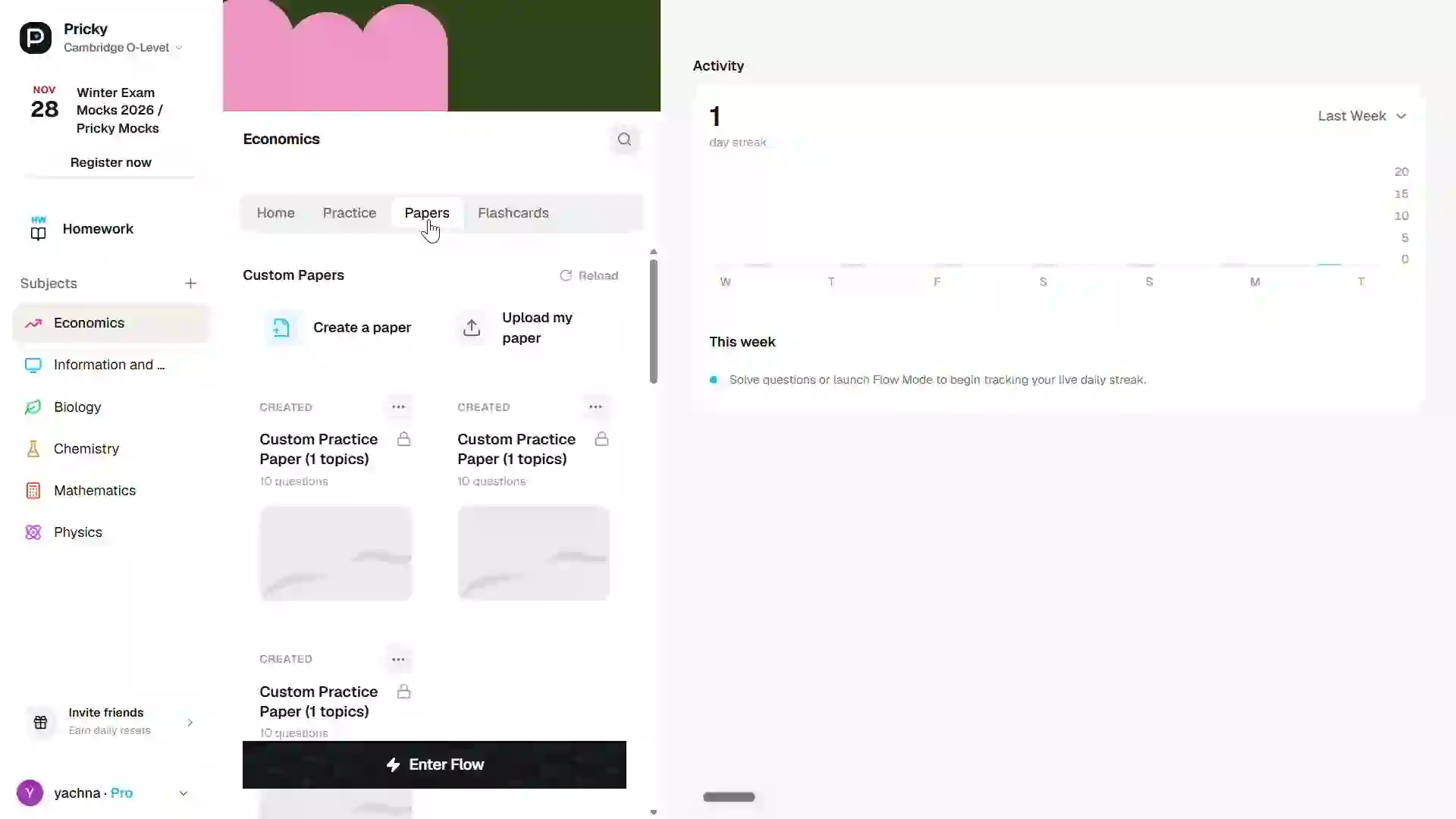
Build a practice paper in PrickyAI
Choose questions for a practice session and work through the paper in the app.
Use different variants to test the same skill
Suppose you lose marks on a question about calculating speed from a distance-time graph. Look up a second syllabus-matched question that also needs a gradient. Work out which axis carries which quantity, choose suitable points and include units. Compare the steps required by the two mark schemes. Then try a mixed question set where you have to identify the method without a topic label.
Use published thresholds only with the same series and component combination. To compare your progress across different practice papers, track recurring errors such as wrong units or an incomplete explanation. Cambridge past papers and mark schemes
What do variant 1, variant 2 and variant 3 mean?
For the two-digit component codes explained by Cambridge, the first digit identifies the paper in the syllabus and the second digit identifies its variant. For example, Physics 0625/41 and 0625/42 are two versions of Extended theory Paper 4. Physics 0625/62 is a version of Paper 6, Alternative to Practical. A specimen can carry a code such as Mathematics 0580/02, so read its title and specimen label as well as its number. Cambridge explanation of component codes · Cambridge 0580 Paper 2 specimen
An entry option refers to the combination of components for a qualification route. A component code identifies one paper in that combination. The administrative zone determines which timetable and arrangements your centre uses for the series. Cambridge says that the variants and option codes allocated to a zone can change by syllabus and series. Your statement of entry and exams officer are the sources to use for your actual papers. Cambridge guidance on entry options across series
| You are trying to find | Use this information |
|---|---|
| The syllabus content you need | Syllabus code, exam year and tier where applicable |
| The correct mark scheme | Syllabus, full component code, year and series |
| The papers your school entered you for | Statement of entry and confirmation from your exams officer |
| The correct qualification grade threshold | Year, series, syllabus and complete component combination |
Worked example: pick the right materials for Physics 0625
Imagine you download a June 2024 Physics question paper marked 0625/61. The first digit after the slash tells you it is a Paper 6 practical-skills assessment. You find a 0625/62 mark scheme and a 0625/61 mark scheme. Use June 2024 0625/61 for the paper in front of you. The matching scheme gives the criteria for the measurements, graph and planning question you actually attempted. For a second round of revision, you can practise a relevant 0625/62 question with its own scheme. Cambridge 0625/61 June 2024 mark scheme · PrickyAI Physics Paper 6 guide
Now consider two students entered for different variants of Extended Physics. One takes a combination that includes 42 and the other takes a combination that includes 43. Their theory papers have the same syllabus role. They should find separate rows when those components appear in separate combinations in the threshold PDF. Compare a mock with its historical row only once you know the whole combination and have calculated the weighted mark.
How to turn two variants into a focused practice session
Start with one recent paper and choose a question that exposed a weakness. For example, a student who calculates the gradient of a voltage–current line with current and voltage reversed needs practice interpreting axes. Find a second question on the same skill in another version. Write the axis quantities and units before calculating. Finish with a question on a different graph, such as force and extension, so you have to read the axes again instead of repeating the earlier formula.
Use another official paper for a timed mock after the targeted session. If your mock is a mix of questions drawn from different series, keep the scores by skill. That lets you see whether graph work improved even when the sets differ in their total marks and difficulty.
Keep a record that makes your next mock easy to find
For each full paper, log the four-digit syllabus code, the component, the series and the year. Add the mark scheme reference and one error worth revisiting. A useful entry might read “0625/61, June 2024, gradient calculated from a raw data point off the line. Next session, choose two separated points on the fit.” That entry gives you a file to reopen and a specific action to try.
Match your PrickyAI practice to the paper you need
In PrickyAI, choose the subject before opening topic practice or building a paper. If you want a full mock, check the component and current format on the original paper. If you want to repair one skill, use a short set with a clear target, such as explaining a trend with two data values.
After each question, compare any feedback with the scheme for that question. When your school publishes a new mock timetable, update the components you have recorded. Keep the practice set and the confirmed exam entry separate so you can use several variants in revision while preparing for the correct paper format.