

Spaced repetition for IGCSE means trying to recall a topic, checking your answer and returning to it after a gap. Review difficult items sooner and leave a longer gap for items you can answer reliably. Start with a schedule you can sustain and adjust it based on performance and the exam date.
What the research says about spacing
In a study on learning prose, students who practised retrieving information retained more on delayed tests than students who spent that time rereading. A separate study found that the best gap depended on how long learners needed to remember the material. These findings support regular retrieval with spacing. They leave the exact review dates open to adjustment. Roediger and Karpicke, 2006 · Cepeda and colleagues, 2008
Start with a five-box Leitner schedule
Write a question on the front of a card and a short answer or worked check on the back. Attempt each answer without looking. Move a correct card forward one box. Return a missed card to the first box, then try it again in the next session. These intervals are an example for planning.
| Box | Time until next review | What to look for |
|---|---|---|
| 1 | Next study day | Can I recall the basic idea? |
| 2 | About 3 days | Can I explain it without a cue? |
| 3 | About a week | Can I apply it in a new example? |
| 4 | About 2 weeks | Can I still recall it in a mixed set? |
| 5 | Later in the month | Can I use it in a timed question? |
Check the due pile before adding more cards. If it takes longer than your available study time, pause new cards and prioritize the topics you keep missing.
Turn a past-paper error into a card
A biology student writes that heating “kills” an enzyme. A better card asks, “Why can enzyme activity fall above the optimum temperature?” A complete answer links denaturation to a change in the shape of the active site and reduced substrate binding. After checking the card, try a question with a different enzyme or graph. Biology Paper 4 examples
For a calculation error, put the original decision on the front. For example, ask which radius to use when the diameter is given, then solve a new cylinder-volume question on paper. Mark the calculation separately from your recall of the formula. Maths Paper 2 practice
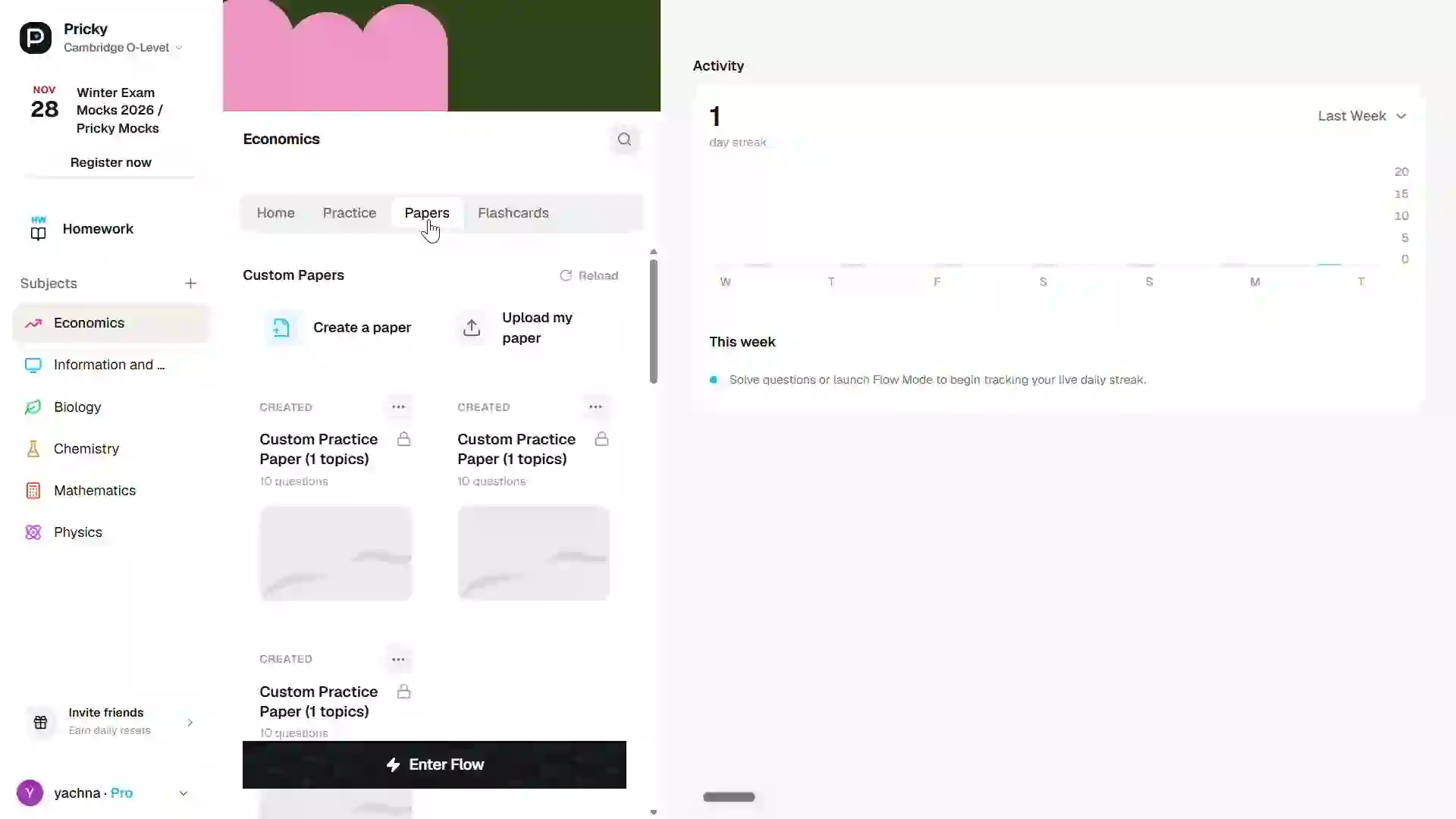
Build a practice paper in PrickyAI
Choose questions for a practice session and work through the paper in the app.
Fit the reviews around timed practice
Use flashcards for short prompts and keep some sessions for mixed exam questions. Mark a full paper against its matching scheme, then turn each recurring error into one specific prompt. In the final week, prioritize your most persistent errors and practise writing complete answers at exam pace. February and March revision plan
What makes an IGCSE flashcard worth keeping?
A good card tests a decision you need to make in the exam. “What is osmosis?” checks a definition. A second card that asks why a plant cell gains water in a dilute solution checks whether you can apply it. Keep the definition and the application on separate cards so you can see which one needs another review. If you keep getting a long card half right, split it into prompts with one answer each.
| Subject | Prompt to recall | Answer to check |
|---|---|---|
| Biology 0610 | Why do many alveoli help gas exchange? | Together they provide a large surface area for diffusion. |
| Physics 0625 | How do you get speed from a distance–time graph? | Calculate the gradient using the change in distance divided by the change in time. |
| Chemistry 0620 | Why use a fresh portion for a second test on an unknown solution? | Reagents from the first test could affect the second observation. |
| Maths 0580 | A quantity falls by 20%. What is the multiplier and how do you reverse the change? | Multiply by 0.8 for the decrease and divide by 0.8 to recover the original quantity. |
Write your answer before turning the card over. For the alveoli card, “more diffusion” is too vague to show that you remembered the relevant adaptation. For the gradient card, give the units if the prompt supplies them. Check the whole relationship, including which quantity goes in the numerator. After a correct recall, apply the idea to a different question to see if you can use it without the card's wording.
Follow one mistake through four review sessions
Suppose a Maths 0580 question asks for the original price of an item now priced at 60 after a 25% discount. You add 25% of 60 and get 75. Your card asks, “Which amount is the 25% calculated from, and how do I find it?” The answer says that the original price is the base. The sale price is three quarters of the original, so 60 × 4 ÷ 3 = 80. You can verify this by taking one quarter of 80 and subtracting it.
On your next study day, recall the method without notes. Three days later, reverse a different discount with easier numbers. A week later, put a reverse percentage question into a mixed set with a direct discount and a percentage increase. At the next mock, check whether you identified the base before doing the arithmetic. If you choose the wrong base in the mixed set, bring that card back into your next session.
The distinction between recalling the multiplier and recognising the situation matters. A flashcard can tell you whether you remember to divide by the multiplier. A mixed set tells you whether you know when to do it. Track those results separately.
Use the PrickyAI question bank and flashcards together
Begin with a short topical set in PrickyAI. Choose one error after marking. Put the decision you missed into your flashcard review, then return to topic practice to try the same idea in a new question. Use the app's spaced review for short prompts and a practice paper for longer answers. PrickyAI flashcard and practice features
For a biology explanation, a review session might start with three short prompts on enzymes, then end with a new graph question. The check is whether you can explain the fall in activity using the shape of the active site and substrate binding. Record the result from the question alongside the card review. If both are correct after a delay, spend the next longer session on another weak topic.
Adjust the intervals when the exam gets closer
If your next paper is in ten days, schedule a review while there is still time to act on a mistake. Try a short check tomorrow and another in a mixed set a few days later. Keep the final day for the most persistent errors, a few short retrieval prompts and preparation for the actual paper. A card scheduled for after the exam can wait unless the skill also appears on a later component.
If the review queue becomes too long, group prompts by the decision they test. Keep one reverse-percentage card and a pair of varied questions instead of five near-identical cards. Reserve a regular block for timed written practice. Use that block to check skills flashcards cannot fully test, such as laying out an explanation, completing a graph or choosing how long to spend on a multi-part question.