
Use AI to get a hint or critique a draft answer, then check any claimed mark against the matching Cambridge mark scheme. Start by writing your own answer so the feedback can address a specific gap in your reasoning.
Ask for a hint before asking for an answer
Include the subject and syllabus code, the question and the working you have tried. Ask the tutor to identify the first step that needs attention. For a physics question, you could write, “I used this equation and substituted these values. Which quantity or unit should I check first?” Try the suggested correction on paper. A second, similar question can help establish whether you understood the method.
Verify feedback one marking point at a time
Open the question paper and mark scheme for the same component, year and series. If the AI awards credit, ask which line in your answer supports it. Then read the relevant marking point and any notes on alternatives, units or acceptable precision. A correct-looking final number can hide a mistake in the working. A different explanation may earn credit if it satisfies the scheme. Cambridge guidance for using practice material
| What you want to check | Ask the tutor | Check yourself |
|---|---|---|
| A calculation | Which step changes the result? | Formula, substitutions, units and rounding |
| An explanation | Which link in my reasoning is missing? | The command word and the required cause or mechanism |
| A data question | Which values support my conclusion? | The axes, units and readings in the question |
| A score | Which marking point does each line address? | The mark scheme for the same paper and series |
Worked example: correcting a vague biology explanation
A question asks why an enzyme’s activity falls at a high temperature. The student writes, “It gets too hot, so the reaction slows.” Feedback can point out the missing causal step. A revised answer explains that the enzyme may denature, changing the shape of its active site so fewer substrate molecules bind. For a real paper, compare the revised answer with the wording and acceptable alternatives in that paper’s mark scheme. Practise with more Biology Paper 4 examples
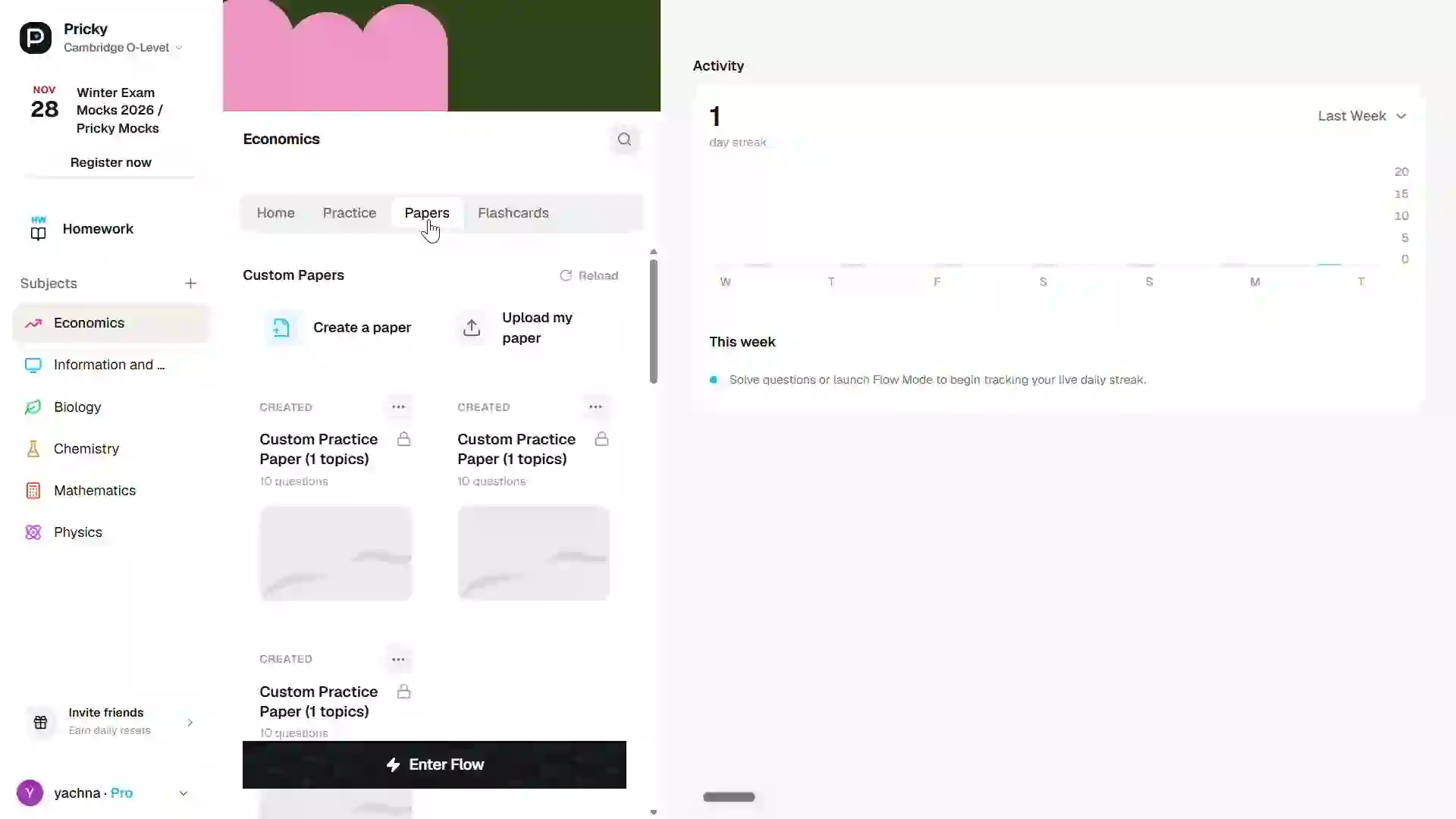
Build a practice paper in PrickyAI
Choose questions for a practice session and work through the paper in the app.
Keep a record you can use in your next session
After feedback, write one sentence about the error and one about the change you will make. For example, “I stated the trend but left out the mechanism. Next time I’ll use the command word to decide what the answer needs.” Reattempt the question later without the chat. Use a full, independently timed paper when you want to assess your pacing and overall coverage.
What should you ask an AI tutor during IGCSE revision?
Give the tutor enough context to evaluate your reasoning. Include the syllabus code, the question wording or a faithful summary, the units and your working. If the question uses a graph, supply the axis labels and relevant values. Tell the tutor whether you want a hint, a check of the reasoning or an explanation of an official marking point you already have. Each is a different task.
| Revision task | A prompt you can adapt | How to verify the reply |
|---|---|---|
| Check a Maths 0580 method | “Show me the first line where the two equations stop being equivalent.” | Substitute the result back into the original equation. |
| Improve a Biology 0610 explanation | “Identify the missing link between the change and its effect. Leave the final wording for me.” | Read the scheme and identify the sentence that provides that link. |
| Check a Physics 0625 practical plan | “Which variable in my method is unclear, and what could I measure more consistently?” | See whether a partner could reproduce the method from your answer. |
| Review a Chemistry 0620 test answer | “Mark which phrases are observations and which are conclusions about the unknown.” | Match each observation and reagent to Cambridge's reference sheet. |
Worked example: catch a unit error in Physics
A practice question gives a charge of 60 C passing in two minutes and asks for current. A student writes “60 ÷ 2 = 30 A.” Ask the tutor to check the time unit while leaving the arithmetic for you. The correction is to convert two minutes to 120 seconds, then calculate 60 ÷ 120 = 0.50 A. You can check the result independently because one ampere is one coulomb per second. Reattempt with 90 C over three minutes, then try a different question that gives time in seconds already.
For a past-paper question, compare the scheme's actual marking points with the working shown. If the tutor assigns a method point, ask it to identify the line of the scheme and the line in your answer. An explanation of how the equation works can help even when the proposed score needs correction. PrickyAI method marks and worked calculations
How to check an AI response before using it in a mock
First check that the response answered the stated command word. If the question asks you to compare two readings, your final answer should address both. Next, confirm the syllabus and component. An answer written for a different course might use material you have not been asked to apply. Finally, check the answer's numbers, units and assumptions. For a calculation you can often estimate the size of the answer or reverse the operation.
Give special attention to a plausible explanation supported by the wrong data. If a tutor says a plant's photosynthesis rate doubles, read the graph and check the two values before copying that claim. If the graph only shows that the rate levels off, give a possible limiting factor when asked to suggest one. A single graph can leave several explanations open.
If you are assessing improvement, write the retry without help. A correct answer produced after a long chat measures something different from a correct first attempt under time pressure. Record whether you needed a hint and what it was. Compare independent attempts over several sessions.
Use PrickyAI for practice, feedback and a fresh attempt
Open PrickyAI, choose the subject and start with a small set that matches your syllabus. Attempt the question on paper or in the practice screen. Use the app's answer feedback to find a specific gap, then close the feedback and rewrite the answer. The question-bank and custom-paper demos show where you can find a new set to practise the same skill. PrickyAI practice and feedback features
For a timed mock, keep feedback closed until the end and use the correct paper conditions. Review the full attempt with its matching mark scheme. If you missed several different skills, choose the one with the clearest correction and practise it first. Add a mixed set later so you can check whether you recognise the method without seeing its topic label.
Choose a practice tool by the work it helps you do
For exam preparation, look for relevant syllabus material, a way to practise independently and enough detail to check feedback. An AI tutor can help explain a step. A past paper gives you the original question context and format. The published mark scheme gives the scoring criteria for that paper. Use the three together when you need to understand both why an answer works and how it would be assessed.