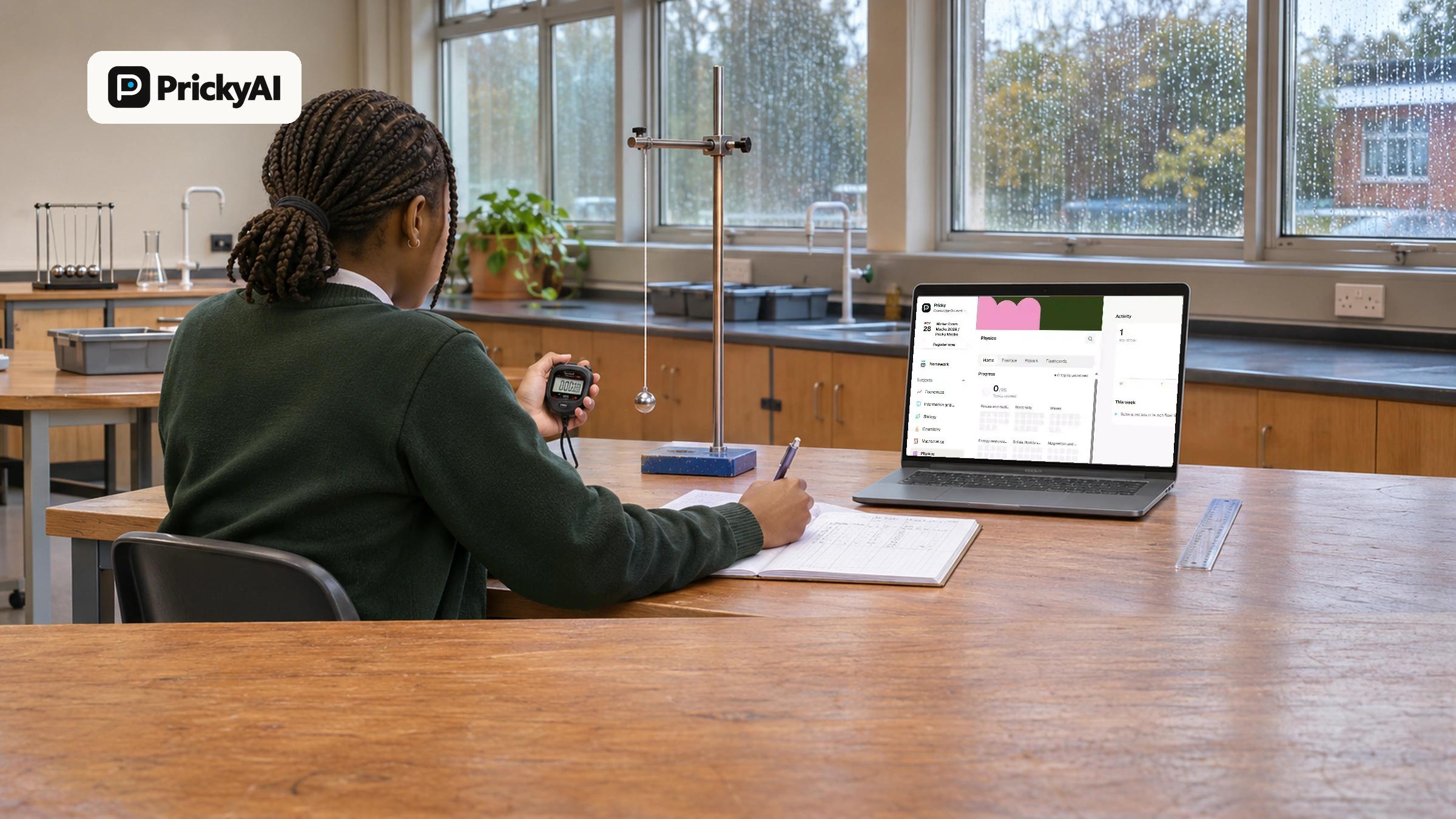


Method marks give credit for specific steps in your working. Write the equation, show substitutions and keep intermediate values unrounded. The question and matching mark scheme determine which steps earn credit. Cambridge Physics 0625/41 marking conventions
Reading Cambridge mark codes
The meanings below summarize the conventions in the linked Physics paper. Check the scheme for your own subject, year and component.
- M1Method
- Credit for the method specified by the scheme. A dependent accuracy mark requires the method mark.
- A1Accuracy
- Credit for the correct result or answer following a credited method.
- B1Independent
- Credit for the specified answer or observation independently of method marks.
- C1Compensatory
- Credit for a specified part of the working. The scheme explains when it can be implied by a correct answer.
Physics 0625 worked example: braking force
Consider this illustrative calculation. A motor vehicle of mass 1200 kg decelerates uniformly from an initial velocity of 28.0 m/s to rest over a braking distance of 65.0 m. The candidate is required to calculate the braking force exerted by the braking system.
Worked marking example
Cambridge IGCSE Physics 0625 Section 1.2 (Motion) & Section 1.3 (Forces)
Calculate the magnitude of the deceleration and the resultant braking force.(4 marks)
[M1]Correct formula for acceleration/deceleration: a = (v^2 - u^2) / (2s) OR v^2 = u^2 + 2as
[A1]Correct numerical deceleration: a = 6.0307... m/s^2
[M1]Correct application of Newton's Second Law: F = m * a (substituting candidate's mass and acceleration)
[A1]Correct final force: F = 7.24 kN to three significant figures
Rounding during the calculation
Candidate A writes:
Then:
Keeping more precision
Candidate B writes:
Then:
Chemistry 0620 worked example: titration
Consider a titration in which of aqueous sodium hydroxide () is neutralized by of dilute sulfuric acid ().
Worked marking example
Cambridge IGCSE Chemistry 0620 Section 3.2 (Moles & Volume of Solutions)
2NaOH + H2SO4 -> Na2SO4 + 2H2O
Calculate moles of NaOH in 25.0 cm3 of 0.0800 mol/dm3 solution.(1 mark)
- [B1]Moles = Concentration * Volume (dm3) = 0.0800 * (25.0 / 1000) = 0.00200 mol
Deduce moles of H2SO4 required for neutralisation.(1 mark)
- Mole ratio NaOH : H2SO4 = 2 : 1
- [B1 or M1]Moles of H2SO4 = 0.00200 / 2 = 0.00100 mol
Calculate the concentration of the sulfuric acid in mol/dm3.(2 marks)
- Volume of H2SO4 = 18.50 / 1000 = 0.01850 dm3
- Concentration = Moles / Volume = 0.00100 / 0.01850 = 0.054054... mol/dm3
- Illustrative result: 0.0541 mol/dm3 (3 s.f.)
- [M1]moles / volume expression with unit conversion
- [A1]0.0541
Convert both volumes from cm³ to dm³ before using them in concentration calculations. The sodium hydroxide volume gives the amount of sodium hydroxide. The acid volume gives the concentration of the acid once its amount is known.
Build a practice paper in PrickyAI
Choose questions for a practice session and work through the paper in the app.
Check your working
- Match the question paper and mark scheme by year, series and component.
- Show the equation, substitutions and unit conversions so each step can be followed.
- Round the final result to the precision requested and include the correct unit.
- Use the published scheme to check any allowance for error carried forward.
Cambridge Chemistry 0620 past papers · Practical Physics Paper 6
How to read a mark scheme alongside your answer
Put the question, your working and the mark scheme next to each other. Underline the quantity the question asks for, then find the corresponding part of the scheme. For each marking point, put a tick beside the line in your answer that supplies the evidence. If you cannot point to a line, write what is missing in the margin. That distinction tells you whether to practise the science or change how you present it.
Cambridge's published Physics scheme for 0625/41 from June 2024 gives a useful example. In the momentum question, several forms of working can demonstrate conservation of momentum. A student might write the equation in symbols or show an appropriate numerical substitution. Read the alternatives as ways to earn the same point. The exact arrangement changes from question to question, so consult the scheme for the paper you are marking. Cambridge Physics 0625/41 mark scheme, question 2 and marking conventions
| What you see in your working | What to check in the scheme | What to practise next |
|---|---|---|
| Correct equation, wrong substitution | Whether the equation or a correct substitution supplies the method evidence | Label the value and unit of each symbol before substituting |
| Right numerical value, unclear unit | Whether the unit is already printed and what the scheme requires | Write the complete quantity and check its dimensions |
| A wrong value carried into the next part | Whether the next part permits error carried forward from that earlier part | Substitute the earlier answer clearly and apply the new method |
| An unexplained calculator result | Whether working or an intermediate value can earn a separate point | Write the calculation in one line before evaluating it |
When error carried forward applies
Suppose an earlier part asks for a block's volume and you incorrectly obtain 24 cm³. The next part gives a mass of 72 g and asks you to calculate density using the volume you found. Writing 72 ÷ 24 = 3.0 g/cm³ shows a correct density calculation using your earlier value. If the actual scheme allows error carried forward from that part and the answer meets its conditions, the later calculation can earn credit. The volume error still belongs in your log. For the next practice question, work on finding the correct volume before repeating density.
Three calculations to practise showing your working
Try these original questions with the answer lines covered. Each solution shows a way to make the method visible. Use official mark schemes to check allocations on actual Cambridge questions.
Physics 0625: find current from a circuit measurement
A resistor has a potential difference of 6.0 V across it. A charge of 48 C passes through it in 2.0 minutes. Find the current and then the resistance. The required time unit is seconds, so 2.0 min = 120 s. Apply I = Q ÷ t = 48 ÷ 120 = 0.40 A. Then apply R = V ÷ I = 6.0 ÷ 0.40 = 15 Ω. If you divide the charge by 2.0, your number is a charge per minute. State the time conversion explicitly so you can see where the current value came from.
Physics 0625: separate the energy needed from the heating time
A heater transfers 18,000 J to 0.50 kg of water. Use 4200 J/(kg °C) for the specific heat capacity and assume all the stated energy heats the water. The change in temperature is 18,000 ÷ (0.50 × 4200) = 8.57… °C, about 8.6 °C to two significant figures. If the heater delivers energy at 300 W, the heating time for that transfer is 18,000 ÷ 300 = 60 s. Read the requested quantity before selecting an equation. The two answers come from the same energy value but describe different things.
Chemistry 0620: turn amount into gas volume
Assume 0.075 mol of calcium carbonate reacts completely with excess acid to produce carbon dioxide. Each mole of calcium carbonate produces one mole of carbon dioxide in this reaction. Using 24 dm³ per mole at room temperature and pressure, the gas volume is 0.075 × 24 = 1.8 dm³, or 1800 cm³. Keep the gas-volume conversion on a separate line if the question changes the requested unit. For the syllabus scope on amounts, solutions and gas volumes, see the Cambridge Chemistry 0620 syllabus.
Build a method-mark practice set in PrickyAI
Pick one source of lost marks, such as cm³ to dm³ conversions. In the PrickyAI question bank, choose Chemistry and practise a small set of questions involving solutions. Do the conversions and substitutions on paper, then enter your answer. Use the feedback to find the first step worth checking and compare it with the published scheme if you are using a past-paper question.
For the next session, mix that skill into a new practice paper so you have to decide for yourself whether conversion is needed. Keep two columns in your log, one for the scientific decision and one for presentation. A repeated mistake such as reversing a mole ratio needs a different practice question. A correct result with no unit needs a final-answer check you can repeat under time pressure.